Refractive errors
Refractive errors are problems in the way the crystalline lens and the cornea focus light on the retina. In order for the eye to send a clear, sharp image to the brain, light rays need to be brought to a point (focused) directly on the retina, and particularly on the center of the retina (the fovea centralis; see the diagram above under "How Do We See?"). In some common disorders, glasses or contact lenses are needed to focus the light.
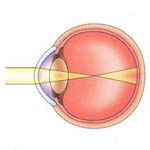
- Near-sightedness(Myopia) occurs in 4% of babies. A person is near-sighted when light rays are focused in front of the retina, rather than on the retina (specifically, light focuses toward the center of the eye rather than on the back of the eye). This can occur when the eye is too deep or the cornea or is too curved.
-
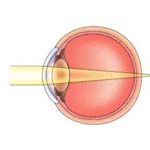
Far-sightedness (Hyperopia) occurs in 20% of babies. A person is far-sighted when the light rays are focused behind the retina, rather than on the retina (specifically, light focuses behind the back of the eye rather than on it). This can happen when the eye is too shallow or the cornea is not curved enough. Most children can correct for far-sightedness by flexing muscles inside their eyes. This constant flexing can cause headaches, eyestrain, and turning of the eye (strabismus).
-
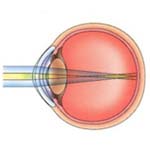
Astigmatism (distortion) occurs in 10% of babies. In this condition, the cornea is football-shaped rather than spherical, and so reflects light in a distorted way. Two perpendicular sets of light rays focus at different points on or near the retina, so the image perceived by the brain is warped. Astigmatism can occur by itself or together with other refractive errors.
Tag Cloud